⚡ Quick Answer: How do you securely deploy OpenClaw for Enterprise?
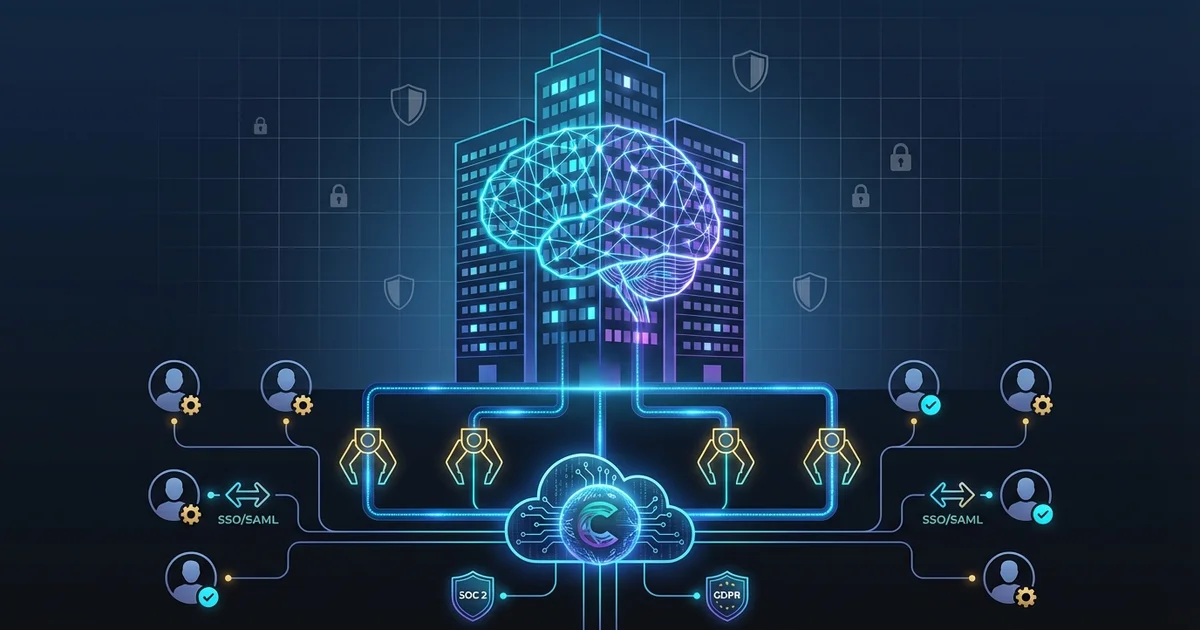
Deploying OpenClaw in an enterprise environment requires isolating the agent's system-level access using dedicated Docker containers or secure VPS instances. Organizations must implement their own SSO/SAML identity management, configure Role-Based Access Control (RBAC) to limit who can issue commands, and secure the agent's persistent memory to meet SOC 2 and GDPR compliance. Alternatively, managed hosting platforms like Clawr.co can automate this entire secure infrastructure.
1. The Rise of OpenClaw
Since its initial launch by Peter Steinberger in late 2025, OpenClaw has completely disrupted the AI landscape. Unlike standard chatbots that simply return text, OpenClaw is an open-source, autonomous AI agent framework capable of executing system-level tasks. It uses popular messaging platforms like WhatsApp, Telegram, Discord, and Signal as its primary user interface, allowing users to interact with their AI as easily as texting a coworker.
However, the true power of OpenClaw lies in its tooling. Out of the box, it can manipulate files, browse the live web, execute shell commands, and manage API integrations. For developers and individual power users, it is a productivity miracle. For enterprise IT departments, however, this level of autonomous power introduces a complex web of deployment and security challenges.
2. How OpenClaw Architecture Works
To understand how to scale OpenClaw, we first must understand its core architecture. OpenClaw does not rely on a single, monolithic proprietary model. Instead, it utilizes a BYOK (Bring Your Own Key) system, allowing developers to plug in their preferred Large Language Models (LLMs) such as OpenAI's GPT-4, Anthropic's Claude 3.5, Google's Gemini, or even open-weight models via Groq or local instances.
The agent operates on a continuous feedback loop. When a user sends a command via a messaging channel, the OpenClaw core processes the intent, accesses its persistent memory files (like MEMORY.md and SOUL.md), decides which tools to invoke, executes the necessary scripts or API calls, and returns the result to the user. This persistent memory system is what allows OpenClaw to "remember" user preferences and ongoing projects across different sessions.
3. The Enterprise Dilemma: Security vs. Autonomy
While OpenClaw is phenomenal for local machine use, deploying it across an organization of 500+ employees is a different story. The primary challenge is security risk. Because OpenClaw has the ability to execute shell commands and modify local files, a compromised agent or a malicious prompt injection could lead to severe data breaches.
Furthermore, as an open-source project, the base version of OpenClaw lacks the built-in enterprise guardrails that CTOs require. There are no native Service Level Agreements (SLAs), no built-in compliance auditing tools, and no centralized way to govern how different departments utilize their agents. To make OpenClaw enterprise-ready, organizations must build an extensive security wrapper around the core framework.
4. Containerization and Data Isolation
The first step in securing OpenClaw for the enterprise is strict data isolation. You cannot run multiple employees' agents on the same bare-metal server. If Agent A suffers a memory leak or a prompt injection attack, it must not be able to access the file system of Agent B.
The industry standard for OpenClaw deployment is utilizing dedicated, headless Docker containers on a secure Virtual Private Server (VPS). Each user or department is assigned an isolated container with its own segregated volume for persistent memory. This ensures that proprietary code bases, financial PDFs, and internal emails analyzed by one agent remain completely walled off from the rest of the organization.
5. Integrating Identity Management (SSO & SAML)
Managing API keys and agent access manually is an administrative nightmare that inevitably leads to shadow IT. Effective enterprise scaling requires integrating OpenClaw deployments with your existing Identity Provider (IdP).
By wrapping the OpenClaw deployment in an authentication layer that supports SAML 2.0 or OIDC, IT teams can connect agent access directly to corporate directories like Okta, Microsoft Entra ID, or Google Workspace. This allows for seamless 1-click provisioning for new hires and immediate, centralized access revocation during employee offboarding.
6. Implementing Role-Based Access Control (RBAC)
Not all OpenClaw users need the same level of access. A marketing associate may only need their agent to browse the web and draft copy, while a senior DevOps engineer needs their agent to have full bash execution rights to deploy code.
Enterprise deployments must implement a granular Role-Based Access Control (RBAC) layer above the OpenClaw core. This involves intercepting tool calls before they execute and validating them against the user's permission matrix. Administrators should be able to dictate exactly which tools (e.g., `web_search`, `exec`, `write_file`) are available to which user groups, thereby limiting the blast radius of any potential errors.
7. Achieving SOC 2 and GDPR Compliance
When autonomous agents handle customer data or internal corporate communications, regulatory compliance is non-negotiable. An enterprise OpenClaw deployment must adhere to SOC 2 and GDPR standards.
- Data Encryption: All persistent memory files and agent databases must be encrypted at rest using AES-256-GCM, and all API traffic must be secured via TLS 1.3.
- Audit Logging: Every action taken by the agent—every web page visited, every file written, and every API call made—must be recorded in an immutable audit log. This is critical for post-incident forensics.
- Data Retention and Scrubbing: To comply with GDPR's "Right to be Forgotten," the deployment must include automated memory scrubbing scripts that can purge sensitive personally identifiable information (PII) from the agent's context window and local storage upon request.
8. Multi-Agent Orchestration
As organizations mature in their AI journey, they move from single-agent setups to complex, multi-agent orchestration. OpenClaw supports the spawning of sub-agents (via isolated ACP sessions) to handle asynchronous background tasks.
In an enterprise setting, a "Triage Agent" might sit in a Slack or Teams channel, intercepting user requests. If a request is complex—such as analyzing a 50-page financial PDF—the Triage Agent securely spins up an isolated, temporary sub-agent with a higher compute threshold to process the document in the background, returning the summary to the user later. This orchestration requires a robust queuing system and load balancing to prevent API rate limits and ensure 99.9% uptime.
9. The Solution: Managed Enterprise Hosting with Clawr.co
Building the infrastructure described above—containerization, SSO integration, RBAC, audit logging, and SOC 2 compliance—takes months of dedicated DevOps engineering. For organizations that want the power of OpenClaw without the massive infrastructure overhead, the solution is managed hosting.
This is where Clawr.co bridges the gap. Clawr is an enterprise-grade hosting platform built specifically for OpenClaw agents. Instead of spending weeks configuring Docker networks and writing authentication middleware, Clawr allows IT teams to deploy secure, isolated OpenClaw agents in under 60 seconds.
How Clawr.co supercharges your OpenClaw deployment:
- Dedicated Infrastructure: Every user gets their own isolated, headless Docker container running on a secure VPS.
- True BYOK Architecture: You bring your own API keys. Clawr never marks up your token costs, ensuring you maintain direct relationships with your AI providers.
- Built-in Enterprise Security: Clawr handles the AES-256 encryption, immutable audit logging, and SOC 2 compliance out of the box.
- Seamless Integrations: Connect your agents to 22+ messaging channels and integrate with enterprise Identity Providers via SAML 2.0/SSO instantly.
Stop wrestling with Linux servers and start scaling your autonomous workforce.
Explore enterprise OpenClaw hosting at Clawr.co today.